How Same-Day Delivery Is Reviving Columbus Small Businesses
How Same-Day Delivery Is Reviving Columbus Small Businesses
Jenna Park doesn't run a ghost kitchen. She runs an actual restaurant—Banchan & Bowl, a 28-seat Korean spot in Clintonville with hanging plants, mismatched chairs, and a chalkboard menu she rewrites every Monday. For years, delivery meant handing off orders to third-party apps that charged 30% and buried her between Chipotle and Panda Express.
Now she's doing 30-minute delivery herself. Sort of.
"I don't have a fleet," Park says, prepping japchae at 11 a.m. on a Tuesday. "But I can ping someone through Lumo when an order comes in, and they're here in eight minutes. My food goes out hot. I keep my margins. And people actually find me now."
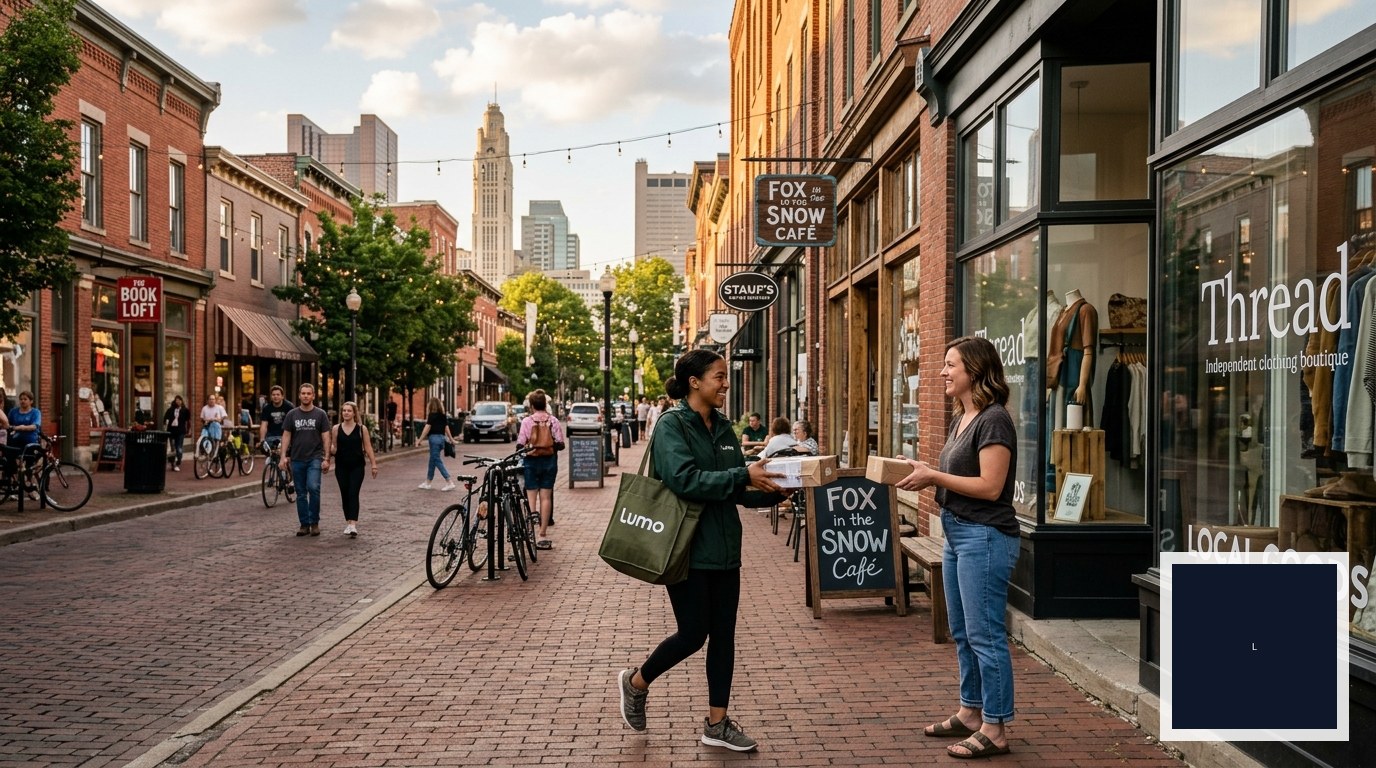
Park is part of a quiet shift happening across Columbus—a city where Big Tech keeps promising disruption but local businesses keep getting squeezed. Same-day delivery platforms aren't new, but the hyperlocal model—where neighborhood couriers, not algorithms, move goods—is changing the math for small operators.
The 4 PM Panic Buy
Three miles south in German Village, Reclaim Vintage was hemorrhaging foot traffic. Owner Marcus Webb had great inventory—'90s Carhartt, vintage band tees, retro furniture—but customers only showed up on weekends. Rent didn't care.
"I posted on Instagram one day: 'DM me what you want, I'll have it to you by dinner,'" Webb recalls. "Sold a $240 denim jacket to someone in Grandview at 4 p.m. on a Wednesday. She needed it for a date."
Now Webb lists items on Lumo's marketplace by noon and fulfills orders same-day. He's reaching customers in Bexley, Worthington, even New Albany—people who'd never drive to German Village on a weekday but will absolutely impulse-buy a $60 lamp at 3 p.m. if it shows up before their partner gets home.
"It's not replacing foot traffic," Webb says. "It's creating a second store that's open to anyone within 10 miles who can't be bothered to find parking."
The margins are tighter than in-store sales, but the volume compensates. Last month, same-day orders accounted for 22% of Reclaim's revenue. Webb hired a part-time picker just to stage orders.
The Gig That Saved Moving Day
Then there's the supply side.
Carla Simmons runs Two Guys and a Truck (she's one of the guys). It's her, her brother, and whatever day labor they can scrape together. Most weeks that's fine. The second Saturday in May—when every Ohio State student moves out—is not most weeks.
"We had six jobs booked and three crew members," Simmons says. "I posted on Lumo at 7 a.m.: 'Need two people who can lift, have a truck or van, Short North to Clintonville.' Had four responses by 7:20."
She hired two—a guy with a Tacoma and a woman with a cargo van. Paid them directly, same day, via the platform. All six moves got done. Nobody's couch spent the night on a curb.
"I'm not outsourcing my business," Simmons clarifies. "I'm pulling in backup when I need it. And honestly, one of those people is now on my regular call list."
For the workers, it's the inverse problem: steady gigs are rare, but platforms like Lumo let them fill Tuesday mornings or Friday afternoons without committing to a boss.
The Bet Columbus Is Making
None of this is revolutionary. It's logistics—old as milk routes.
But what makes it work in Columbus is scale that's still human. A courier can cross from Franklinton to Easton in 40 minutes. Businesses know their customers by neighborhood, not ZIP code. And when someone orders bibimbap at 6 p.m., it's probably going to someone who actually knows where Clintonville is.
"National apps made everything feel like a warehouse," Park says. "This feels like my block just got bigger."
She's closing in on 400 same-day deliveries since June. She's hiring a second line cook next month.
Webb's thrift shop is considering a weekend pop-up in Short North—funded entirely by weekday delivery revenue.
And Simmons? She just bought a third truck.