
Hourly vs. Flat-Rate: How to Price Your Services the Right Way

When you're setting prices for cleaning, handyman work, moving, yard care or any other service, you face a choice: charge by the hour or quote a flat rate for the whole job. Pick wrong and you'll either scare off customers with prices that seem too high or end up working for $15 an hour when you meant to earn $40.
The right pricing method depends on the type of work, how predictable the job is, and what customers in your market expect. This guide walks through both approaches with real numbers, shows you when to use each one, and gives you formulas to set prices that keep you booked and profitable.
- 01
Step 1: Understand what hourly pricing really means

Service worker checking the time on wristwatch while working on a project Hourly pricing means you charge a set rate—say $35 per hour—and bill for the actual time spent working. You estimate how long the job will take when the customer books, but the final price adjusts based on real hours. This works well for jobs where the scope can change: deep cleaning a house that turns out dirtier than expected, handyman repairs that reveal hidden problems, or yard work where the customer adds tasks as you go. The customer knows your rate upfront but understands the total may vary. Most workers in your city charge $25–$50 per hour for general services, $40–$75 for skilled trades, and $50–$100+ for specialized work like appliance repair or electrical tasks.
- 02
Step 2: Know when flat-rate pricing makes more sense

Professional handyman writing a price estimate on clipboard for home repair job Flat-rate pricing means you quote one price for the entire job before you start. A customer books 'deep clean, 3-bedroom house' for $180, or 'mount two TVs' for $120, and that's what they pay regardless of whether it takes you two hours or four. This works best for jobs you can scope accurately: standard house cleaning, furniture assembly, basic moves where you've seen photos, lawn mowing when you know the lot size, or any task you've done dozens of times. Customers love flat rates because there are no surprises. You benefit when you get faster with experience—a job that paid $120 and took three hours at first might take you 90 minutes after you've done it fifty times, effectively doubling your hourly rate.
- 03
Step 3: Calculate your effective hourly rate for flat-rate jobs

Calculator, notepad and pen on desk for calculating service job pricing Before quoting any flat rate, estimate how long the job will actually take and work backward to your hourly rate. If you want to earn $40 per hour and a furniture assembly will take 90 minutes, your minimum flat rate is $60. Add 20–30% buffer time for unexpected issues—that same job becomes $75–$80. Include drive time in your math: if the job takes 90 minutes but you spend 30 minutes driving, you need to charge for two hours of your time. Track your actual time on the first few jobs of each type so your estimates get accurate. Write down: job type, your quote, actual time spent (including drive), and the hourly rate you actually earned. Adjust your flat rates until you're consistently hitting your target hourly income.
- 04
Step 4: Set minimum charges to protect your time
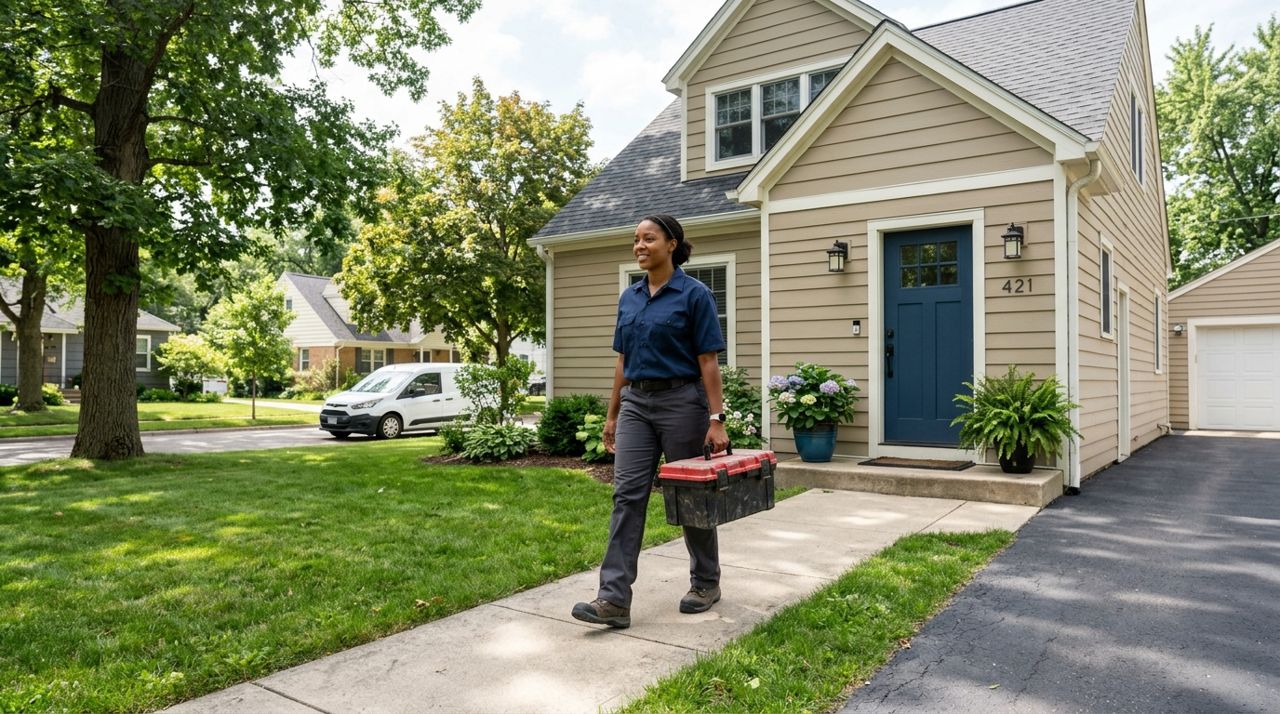
Service professional carrying toolbox arriving at customer's home for repair appointment Every job costs you time to travel, communicate, and invoice even if the actual work is quick. Set a minimum charge that covers at least 90 minutes of your time—if your rate is $40/hour, your minimum is $60 even for a 20-minute task. This prevents unprofitable jobs where you drive 25 minutes, fix a loose door hinge in 10 minutes, and earn $15. Most workers set minimums of $50–$100 depending on their market. When someone books a small job through Lumo, be clear in messages: 'My minimum charge is $75, which covers up to 90 minutes. This job should take about 45 minutes, so if you have other small tasks, I can handle those in the same visit at no extra cost.' Bundling small jobs into one visit makes your minimum fair and increases your effective hourly rate.
- 05
Step 5: Use hybrid pricing for unpredictable jobs

Close-up of mobile phone showing professional text message conversation with client Some jobs fall between hourly and flat-rate. Try 'flat rate with hourly overage': quote $150 for a basic bathroom cleaning, 2 hours included, then $40 for each additional hour if the customer adds tasks or the space needs more work. Or offer 'hourly with a cap': $45/hour up to a maximum of $200 for a full-day project, so customers know their worst-case cost. Another option is diagnostic flat rate plus hourly labor: charge $75 to show up and diagnose an appliance problem (keeps tire-kickers away), then quote hourly or flat for the actual repair. Make the structure clear when the customer books—use Lumo's in-app messaging to send a quick note like 'Job is $120 flat for standard garage cleanout, or $40/hour if there's more than 2 truckloads.'
- 06
Step 6: Test and adjust based on booking patterns

Service worker reviewing fully booked calendar schedule with multiple client appointments Watch what happens when you change your pricing. If you're booked solid every day, you're priced too low—raise your rates 15–20% and see if bookings stay strong. If you get lots of inquiries but few bookings, you might be priced too high or your descriptions aren't clear. Try this: offer the same service both ways and see which sells better. List 'House cleaning: $40/hour, typically 2–3 hours' and also 'Standard house clean: $110 flat rate' and track which gets more bookings. A/B test for a month, then go all-in on the winner. On Lumo, you keep 90% of what you charge, so a $100 flat-rate job puts $90 in your wallet. Adjust your prices every 8–12 weeks based on demand, your speed improvements, and what competitors charge.
- 07
Step 7: Communicate pricing clearly to avoid disputes

Service professional showing phone screen with job details to customer before starting work Whatever structure you choose, explain it before the customer books. For hourly work, give a realistic time range: 'This usually takes 2–3 hours at $45/hour, so expect $90–$135.' For flat rates, list exactly what's included: 'Full yard mowing and edging, $85. Bagging clippings is an extra $20.' Send a message through the app confirming the agreed price and scope before you start. Take before photos of complicated jobs so you can show what you walked into if the customer disputes the time or price. After you finish, summarize what you did: 'Completed: cleaned 3 bathrooms, vacuumed all floors, wiped kitchen. Total time: 2.5 hours at $40/hour = $100 as estimated.' Clear communication prevents bad reviews and gets you rehired.
Pro tips
- Add a 20% 'difficulty premium' to flat rates for jobs in hard-to-reach areas, homes with stairs, or during peak times like weekends.
- For repeat customers, offer a small hourly discount ($40 instead of $45) to build loyalty—regular income beats one-time premium rates.
- If a flat-rate job runs way over your estimate, finish it but raise your price for that job type going forward; don't eat losses repeatedly.
- Check what others charge by searching your city + service type; price within 10% of the median unless you offer something clearly better or faster.
Frequently asked questions
- What if a customer haggles over my price?
- Politely hold firm or walk away. Say 'My rate reflects my experience and the quality I deliver. If that doesn't fit your budget, I understand.' Customers who haggle hard often leave bad reviews regardless of your work. Protect your time for people who value it.
- Should I charge more for same-day or urgent requests?
- Absolutely. Add 25–50% to your normal rate for jobs booked with less than 4 hours notice. Urgent jobs disrupt your schedule and force you to rearrange other commitments, so the premium is fair and most customers expect it.
- How do I switch from hourly to flat-rate without losing customers?
- Run both options for a month so customers can choose. Most will pick flat-rate if the price feels fair. After the test period, stick with whichever method gets you more bookings at your target income level.
The best pricing structure is the one that keeps you booked at an hourly rate you're happy with. Start with one method, track your real earnings per hour for thirty jobs, then adjust. When you use Lumo to find work, you set your own prices and keep 90% of what you charge—the app just connects you with people who need your skills. Price right, communicate clearly, and your calendar fills up with profitable jobs.
Photos are illustrative. Service prices are typical ranges and vary by city. How we write our guides.
More guides like this

How to Set Up Job Alerts for Your Radius and Job Types
Getting the right job alerts means you'll spend less time scrolling and more time earning. Here's how to set your radius and choose the job types that match your skills and schedule.

How to Go On Duty and Set Your Working Hours in Lumo
Lumo gives you complete control over when you receive job alerts. Learn how to go on and off duty instantly, set recurring working hours, and manage your availability so you only get pinged when you actually want to work.

Building a worker profile with photos that wins more bookings
Your profile is the first thing customers see before booking. A clear photo, specific skills and honest descriptions help you stand out and win more jobs.